Health Plan Care Coordinator Certification Program: Child Welfare
Helping health plans strengthen care coordination for children and families in the child welfare system.
Health plans are under increasing pressure to meet the complex needs of children and families involved in child welfare systems, a population that often faces trauma, behavioral health needs, and instability. Delivering the standardized, trauma-informed care these members deserve isn’t easy, especially with care coordinator turnover, inconsistent training, and fragmented communication between child welfare and healthcare systems. The Sellers Dorsey Health Plan Care Coordinator Certification Program gives health plans a proven path to close that gap.
The Bar Is Rising
Care coordination is quickly becoming a contractual requirement, not just a best practice.
CMS requires MCOs to coordinate services and ensure continuity of care, and CMS/ACF points to care coordination as essential to meeting the complex needs of children in foster care. (eCFR.gov)
The CMS Managed Care Access, Finance & Quality Final Rule and the new quality rating system raise the stakes for demonstrating coordinated, quality care. (CMS.gov)
States are required to monitor MCO compliance with care coordination and care transition standards, and may write coordination requirements directly into managed care contracts.(eCFR.gov)
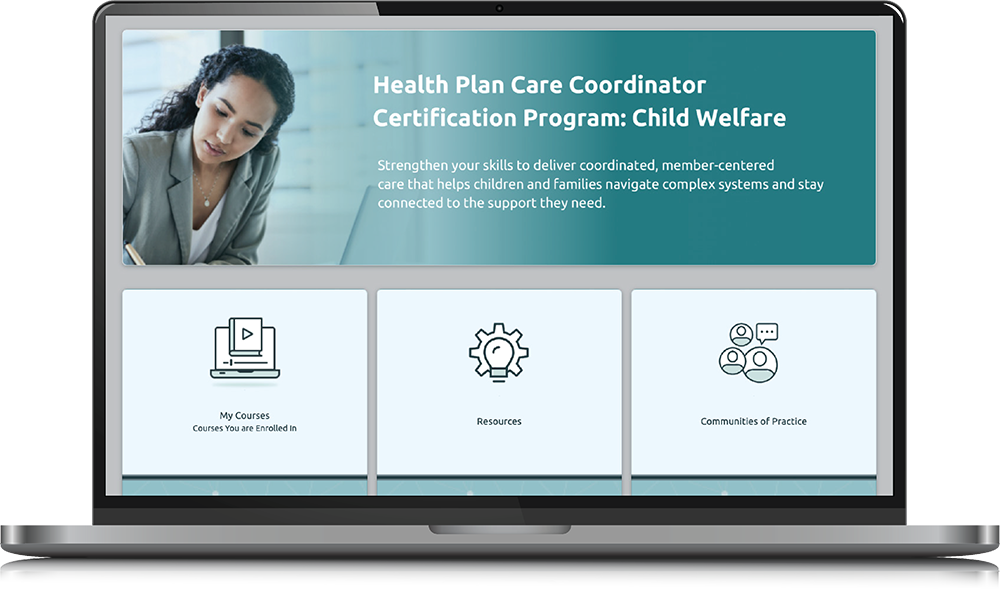
What's Included
A first-of-its-kind training program built specifically for care coordinators and approved by the National Certification Board for Child Welfare Professionals.
A comprehensive curriculum spanning six courses covering key child welfare-focused care coordination competencies.
Curated resources care coordinators can use in day-to-day practice.
Facilitated sessions where care coordinators connect, share experiences, and learn from one another.
Continued learning that reinforces skills and provides CTE credits for certification renewal.


Helping Health Plans Step Up Where the System Falls Short
A fully trained, certified care coordination workforce drives measurable results:
- Better care coordination through standardized core competencies and consistent, high-quality care planning.
- Stronger compliance and reduced documentation risk through standardized practices.
- Improved quality performance, including well-child visits, immunization compliance, follow-up care, and medication monitoring.
- Competitive differentiation in an increasingly scrutinized area of managed care.