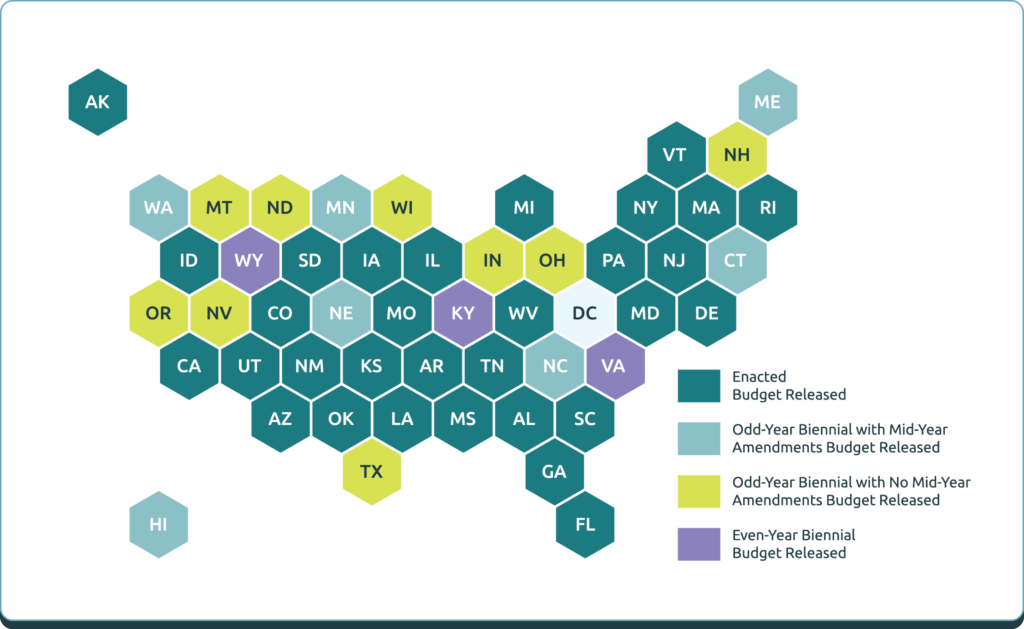
Sellers Dorsey experts summarized states’ enacted budgets for fiscal year (FY) 2027, with an emphasis on spending priorities related to healthcare, child and family well-being, and education. While many states adopt budgets annually, others operate on a biennial basis.
States with odd-year biennial budgets with no amendments are excluded from this work. At the time of publication, all states have enacted FY2027 budgets. Six state legislatures (Massachusetts, Michigan, New York, North Carolina, Pennsylvania, and South Carolina) exceeded their constitutional deadlines to pass a budget but generally had a much shorter gap from continuing resolution to full budget compared to previous fiscal years.
State of Play for Budgets:
Heading into FY2027, states are in a holding pattern. Generally, revenue growth has been steady; collections for FY2026 either met or exceeded projections in most states. In conjunction, Rainy Day and other reserve funds remain at historic highs across states. This mirrors FY2025 revenue collections, which were overall modest but positive, coming down from the substantial growth in FY2021 and FY2022. Pew Research indicates that, while growth exists, quarterly state revenue receipts remain below long-term trends.
Looking ahead, states must weigh many different factors impacting their budgets in FY2027 and beyond:
H.R. 1 and New Federal Policies
- States must address FY2027 budgetary constraints stemming from H.R. 1, mostly centered around the Supplemental Nutrition Assistance Program (SNAP), as states will begin to take on new costs of administering the program this fiscal year and will need to reduce error rates by the end of calendar year 2026 before the benefit cost-sharing requirements fall into place on October 1, 2027 (Federal Fiscal Year 2028), disproportionately impacting states with higher error rates.
- New costs associated with implementing community engagement requirements, along with more frequent eligibility determinations for the Medicaid expansion population, will occur in FY2027 and beyond.
Get the full executive summary in its entirety for additional insights on state budget themes across Medicaid, healthcare, child and family well-being, education, cost of living, and more.
Plus, become a member of Sellers Dorsey IQ to get full access to our extensive library of resources, including year-over-year analysis of enacted state budgets.